Scripps Sunday- Alaska Edition #14
In 1840, the composer Robert Schumann wrote a lieder (art song) for his soon-to-be wife, Clara (herself an accomplished musician). He took his lyrics from the poet and linguist Friedrich Rückert. The result was a piece called Widmung (“Dedication”), considered to be one of the most lush and profound love songs ever written. It went like this:
“You are my soul, you are my heart,
You give me joy, or pain impart,
You are my world –
The world I gladly live in.
You are my grave,
My very heaven!
…Your eyes transfigure me and raise me high.
…[You are] my very soul, my better self!”
Schumann and Rückert lived and worked during the period of European culture we call “Romantic.” The meaning of the word “Romantic,” of course, has changed over time. Originally, it denoted something “ancient-Roman-ish,” evoking bygone, heroic, and mythic things. Tempestuous love stories and passionate quests were a part of the original “Romanticism,” to be sure, but so were ghost stories, ancient ruins, and tales of demons and monsters. Over time, however, the word would narrow to acquire its current meaning. Schumann’s Widmung is a classic example of Romantic-era art that is also modern-day “romantic.” It set the stage for a million more love songs, poems, novellas, and romantic movies.
We often forget, however, that love of this kind (“your eyes transfigure me and raise me high”) was born as a religious emotion! Among other things, the “Romantic age” – working downstream of the Enlightenment – desublimated divine love and connected it tightly to human eroticism. For the nineteenth-century elite, the total, self-immolating emotional investment Robert Schumann describes could no longer rest in a divine object. As a result, human relationships had to bear the weight of its grandeur.
Meanwhile, two hundred years before, the Italian sculptor Gianlorenzo Bernini had created his passionate “St Teresa in Ecstasy,” based on the writings of St. Teresa of Avila. Here, a toppling nun in voluminous robes receives an arrow to the heart from a smiling angel. This angel isn’t Cupid, but he certainly recalls that winsome Roman god! Meanwhile, the nun (St. Teresa) is literally smitten with love not for a human partner, but for an “offstage” divinity uncapturable by human touch or the techniques of art.
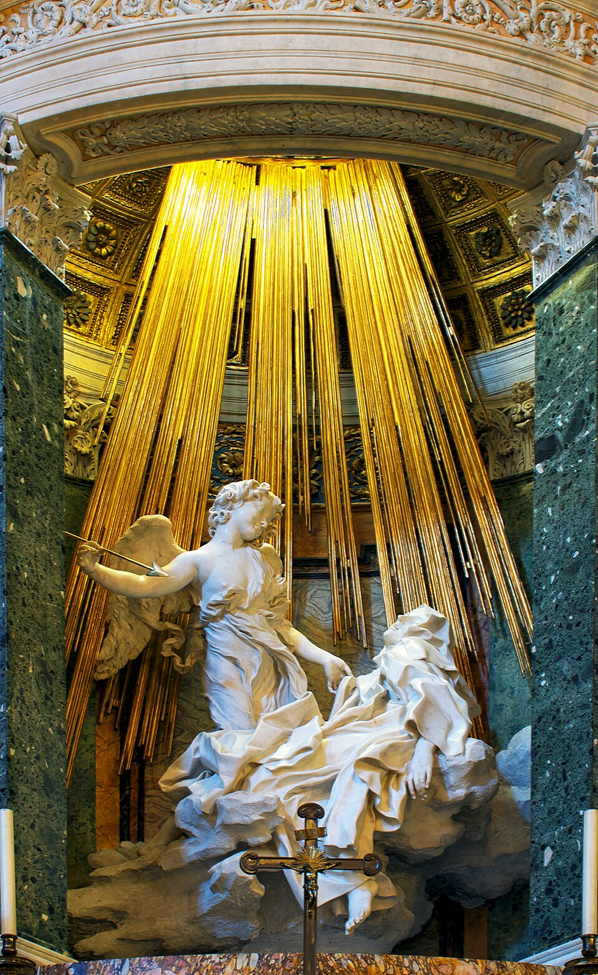
In premodern Europe, Teresa’s experience was only one among many well-known spiritual “romances” that utterly transcended and outshone earthly attachments. Today, images like Bernini’s can seem alienating, distasteful, or strange. But they hailed from a rougher time when the insufficiency of human relationships was keenly felt, and when daily awareness of the numinous and sacred was much more acute. Not until the epistemological crises of early modernity would “romance” like this be fully displaced to the touchable, measurable realm of the five senses. Not until the age of “Romanticism” would Clara Schumann (at least, for a moment) fill the role of a god.
And so, as Valentine’s Day approaches, may we – may I – consider a slightly different Widmung (Dedication):
It is not mortal gaze that gives me life, but the gaze of the transcendent God. This gives me meaning – it constitutes me.
I am what God sees, and what He sees, only. Outside of His gaze, nothing is true.
Like Peter, I walk to God on water, and I must look to Him alone. If I look right or left, above or below, I will fall.
If everything else sheared away from me – if I became displaced, abandoned, forgotten, even amnesiac – it would not matter. My purpose lies only in my tethering to God.
I must not have ulterior motive when I come to Him. I cannot seek heaven (his palace), my own pleasure, or an appearance or righteousness. I must come to Him for Himself and for that only. This is what His romantic heart demands.
Though his creatures (wives and husbands) resemble Him and give foretastes of Him, they cannot replace Him. In the end, they will be amputated from us, one by one, until they can be completely reintegrated under the mastering love of God. The process can be harsh or gentle, long or slow, but it is inexorable. It is the only way.
Who am I?
Not my human relationships.
Not my vocation and achievements.
Not my legacy, passions, or talents.
Not even my history and memories.
I am only a beloved thing constituted by God’s gazing eyes. Only there do I exist. If I forgot my own name, it wouldn’t matter.
In His gaze lies “my very soul, my better self.”


Comments
Post a Comment